
Skin Cancer
Seeing new spots? It may be time to have your skin checked. Skin cancer is the most common cancer in the United States, affecting an estimated one in five Americans. If you have a new or changing spot on your skin, we encourage you to make an appointment for an evaluation. In almost all cases, the sooner we find skin cancer, the easier it is to cure. Monthly self-examinations can also help you get to know your skin better – making any changes more noticeable.
Learn more below about the most common forms of skin cancer as well as possible warning signs and symptoms. If you notice any of the below, please call our offices at (704) 375-6766 to schedule an evaluation or click here to book an appointment online.

Basal Cell Carcinoma
Basal Cell Carcinoma (BCC) is the most common form of skin cancer. BCCs often appear on skin that has been repeatedly exposed to the sun (i.e. face, scalp, ears, hands, neck) but may also occur elsewhere on the body. Slow-growing and highly-treatable, BCCs could cause further damage to surrounding skin if ignored for too long.
Signs & Symptoms
- Spots that won’t completely heal
- Spots that heal but then come back
- Spots that bleed or itch frequently
- Weepy & crusty spots
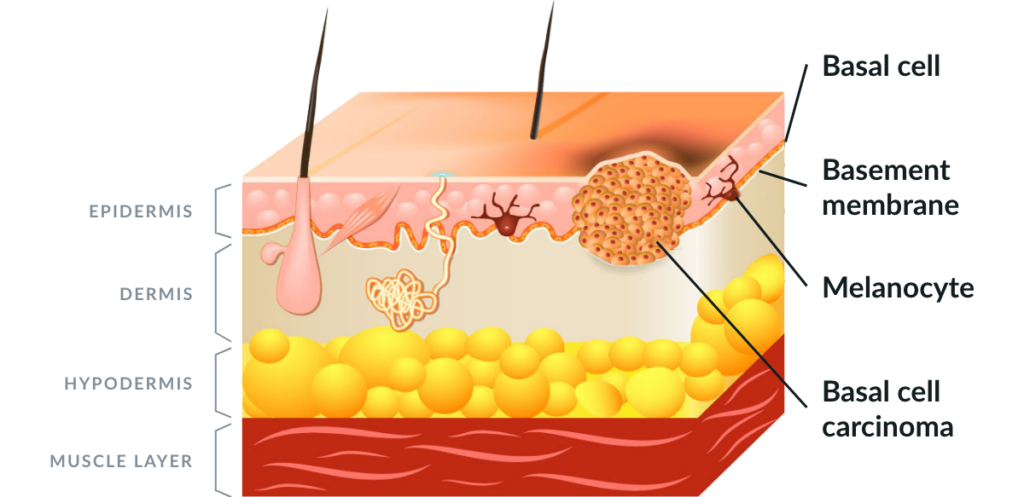
Various Types
- Superficial BCC: flat, pink or red patch that grows outwardly on the skin; may have slightly raised borders and look shiny or scaly
- Nodular BCC: pearly, white, pink or flesh-colored growth, often dome-shaped (or sometimes flat) with tiny visible blood vessels; may have a depressed center or ulceration
- Sclerosing BCC: pale flesh-colored or white growth, often flat (or sometimes raised); may feel waxy or firm and could look like a scar or become depressed
Squamous Cell Carcinoma
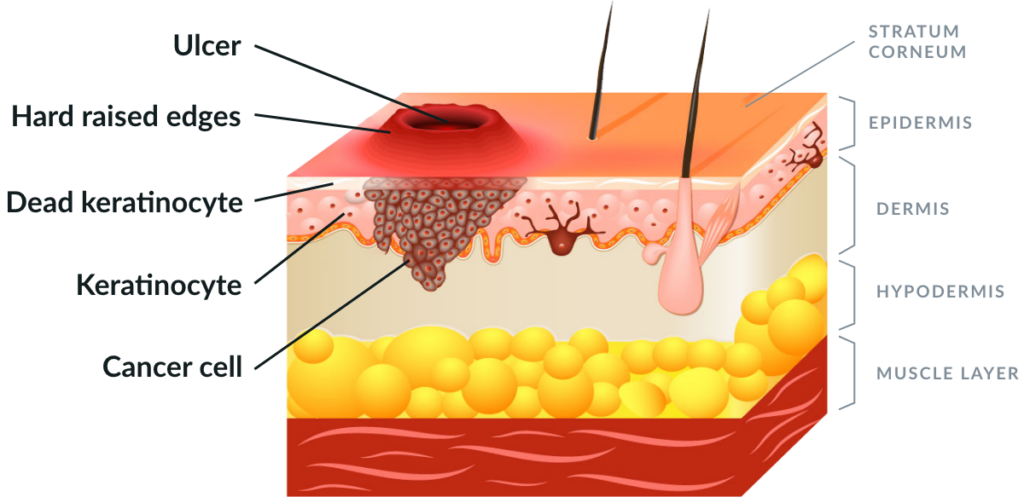
Squamous Cell Carcinoma (SCC) typically shows up on skin that has had repeated sun exposure (i.e. face, scalp, ears, hands, neck) but could occur elsewhere on the body. SCCs usually grow faster than BCCs, but are still considered highly-treatable. Damage to surrounding skin could progress quite rapidly if left untreated.
Signs & Symptoms
- Spots that never seem to heal
- Spots that heal but then come back
- Spots that tend to bleed easily & often
- Rough, crusty or scaly spots
Various Types
SCCs are usually persistent in nature and distinguishing between the types can be difficult.
- SCC in-situ or Bowen’s Disease: red, pink scaly patch, usually flat or slightly-raised; generally grows slowly, but could become ulcerated
- Keratoacanthoma: red, pink or flesh-colored growth that appears suddenly and then grows rapidly; has a central “plug” or indentation that may bleed
Malignant Melanoma
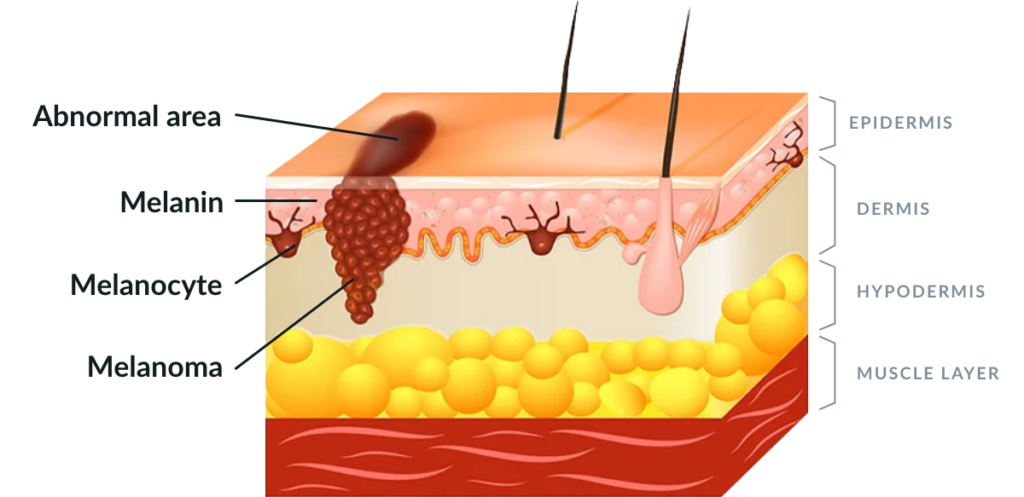
Malignant Melanoma (MM) is by far the most dangerous form of skin cancer with incidence rates growing year after year. If caught early, MM is highly-curable; however, prompt detection and surgical removal are essential. Those with fair skin and/or family history of melanoma are at a higher risk, but people of all skin types can be affected. MM is now the most common form of cancer in people aged 25-29, with indoor tanning beds thought to be a contributing factor to this statistic. Repeated exposure to UV light is known to be a major cause. Any time you are out in the sun, protect your skin with a broad-spectrum sunscreen of SPF 30 or higher, applied every 2 hours – all year long.
Signs & Symptoms
- Spots that look different or stand out from your other moles
- Spots that seem to be changing quickly
- Spots that itch or bleed easily
ABCDEs of Melanoma
- Asymmetry
- Borders – the outdoor edges are uneven
- Color – dark black or have multiple colors
- Diameter – greater than 6mm
- Evolving – changing in size, shape and/or color